
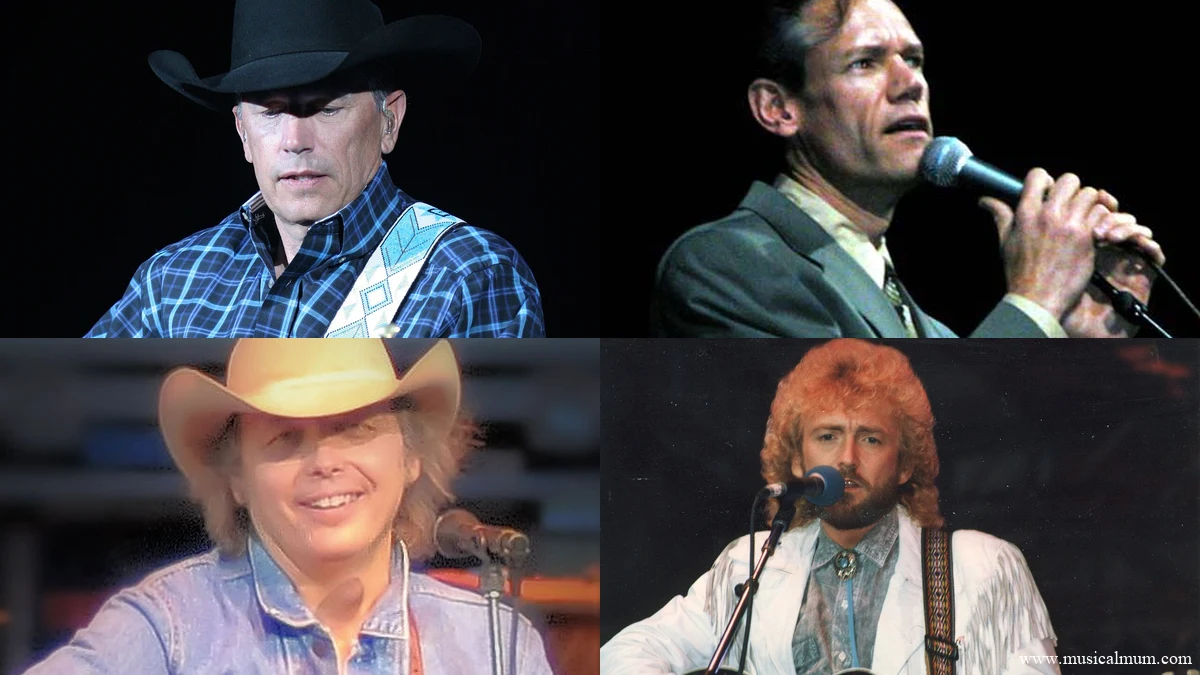
George Strait and Randy Travis helped bring the sound of honky-tonk back to country radio in the 1980s. Ricky Skaggs brought bluegrass into the mix, Dwight Yoakam turned to Bakersfield, and Steve Earle took country songwriting into rock territory.
These eight singers made records that help explain why country sounded so different from one end of the decade to the other. Each profile centers on work released between 1980 and 1989.
Contents
1. George Strait
Strait came out of the Texas dancehall circuit, and his 1981 debut Strait Country carried that sound onto country radio. His first hit, “Unwound,” had the fiddle and steel guitar you’d expect from a honky-tonk record. Even at a quick tempo, Strait sounded like he had all the time he needed to finish a line.
That ease suits the rodeo rider in “Amarillo by Morning.” For the western swing side of Strait, try his version of “Right or Wrong,” a tune associated with Bob Wills that became a No. 1 country hit for Strait in 1984.
2. Randy Travis
On Storms of Life in 1986, Travis brought a low baritone and an unhurried delivery to songs like “On the Other Hand” and “Diggin’ Up Bones.” The debut’s sales showed Nashville that a singer with an old-school country sound could reach well beyond the honky-tonk crowd.
On 1987’s Always & Forever, “Forever and Ever, Amen” takes a simple promise and lets the band carry it along. Listen for the way Travis stretches the last words of a line without slowing the song down.
3. Dwight Yoakam
Yoakam came up playing Los Angeles clubs, where his twang fit alongside punk and roots-rock acts. His 1986 major-label debut, Guitars, Cadillacs, Etc., Etc., brought Bakersfield country back into focus. On the title track, Pete Anderson’s sharp electric guitar is as recognizable as Yoakam’s high, pinched vocal.
The connection to Bakersfield became even clearer in 1988, when Yoakam recorded “Streets of Bakersfield” with Buck Owens. The duet went to No. 1 on the country chart.
4. Keith Whitley
Whitley sang bluegrass with Ralph Stanley before moving into mainstream country. On 1988’s Don’t Close Your Eyes, he carried that phrasing into slower songs. Listen to how gently he eases into the chorus of “When You Say Nothing at All.” The band leaves him plenty of space.
His solo breakthrough came late in the decade. He died in May 1989, a month after “I’m No Stranger to the Rain” reached No. 1. He had further chart-toppers after his death, including “I Wonder Do You Think of Me.”
5. Ricky Skaggs
Waitin’ for the Sun to Shine, Skaggs’s 1981 major-label debut, kept the tight harmonies and nimble picking of bluegrass but added electric bass and drums. “Crying My Heart Out Over You” and “I Don’t Care” both reached No. 1 on the country chart.
Skaggs took Bill Monroe’s “Uncle Pen” to No. 1 in 1984. If you want to hear how close his country hits stayed to the music he grew up playing, start with the fiddle in that recording.
6. Hank Williams Jr.
On The Pressure Is On in 1981, Williams’s voice sounded as at home over electric guitars as it did over a quiet country arrangement. “A Country Boy Can Survive,” released as a single in 1982, is built around his plainspoken descriptions of rural life and the force with which he delivers them.
Williams won the Country Music Association’s Entertainer of the Year award in 1987 and again in 1988. His success shows how much room the decade’s country audiences made for a louder Southern rock sound alongside the more traditional records.
7. Steve Earle
Earle’s 1986 album Guitar Town topped the country album chart, but the road stories and electric guitars had plenty in common with rock. The title song sounds like it’s already moving before he’s done with the first line.
By Copperhead Road in 1988, the sound had grown heavier. The title track still tells a country story, following a family’s moonshine business into a later generation, but the drums and guitar give it a different kind of momentum from the honky-tonk records on this page.
8. Rodney Crowell
Crowell had written hits for other singers before his 1988 album Diamonds & Dirt gave him five No. 1 country singles of his own. “I Couldn’t Leave You If I Tried” is a good example of how easily his writing sits in a brisk, danceable arrangement.
The same album includes “After All This Time,” a slower performance that won a Grammy for Best Country Song. Hearing the two together makes clear why other singers had been recording his material for years.
Featured image: Top left — George Strait: Craig ONeal, CC BY-SA 2.0 (crop)
Top right — Randy Travis: Gerry J. Gilmore, U.S. Department of Defense
Bottom left — Dwight Yoakam: Dirk Hansen, CC BY-SA 2.0 (crop)
Bottom right — Keith Whitley: Christina Lynn Johnson, CC BY-SA 2.5 (crop)


