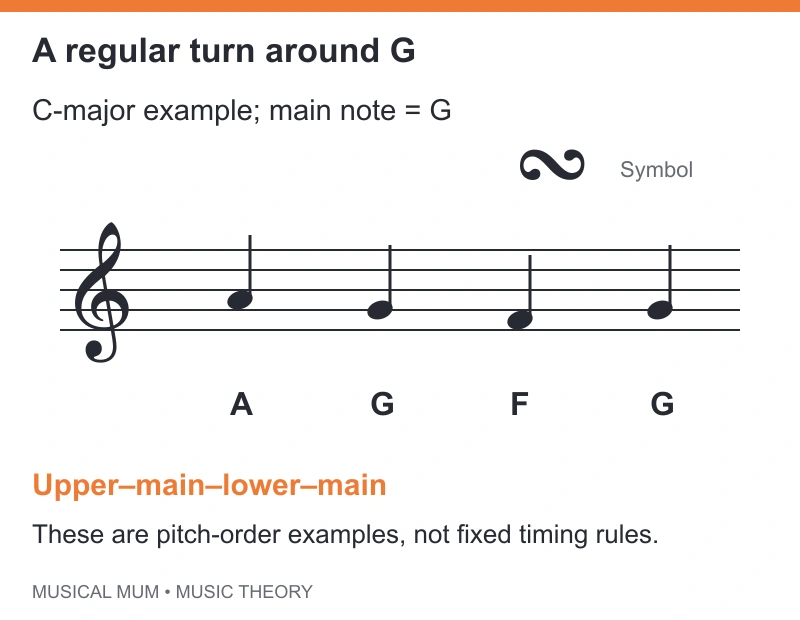
A sideways S in music usually denotes a turn. A regular turn moves through the note above, the main note, the note below, and the main note again. An inverted turn starts with the lower neighbor instead.
A regular turn around G in C major uses A–G–F–G. The exact timing depends on where the symbol is placed and the style of the piece.
What is a Turn in Music?
A turn, or gruppetto, is an ornamentation technique where you move from one note to another and return to the starting note. It’s indicated by an S symbol placed above a note or between two notes.
The turn prompts the musician to swiftly play a set of notes. The speed varies based on the music and the musician’s choice.
Regular Turn
For regular turns, four notes play quickly: the note above the main note, the main note itself, the note below it, and then the main note again.
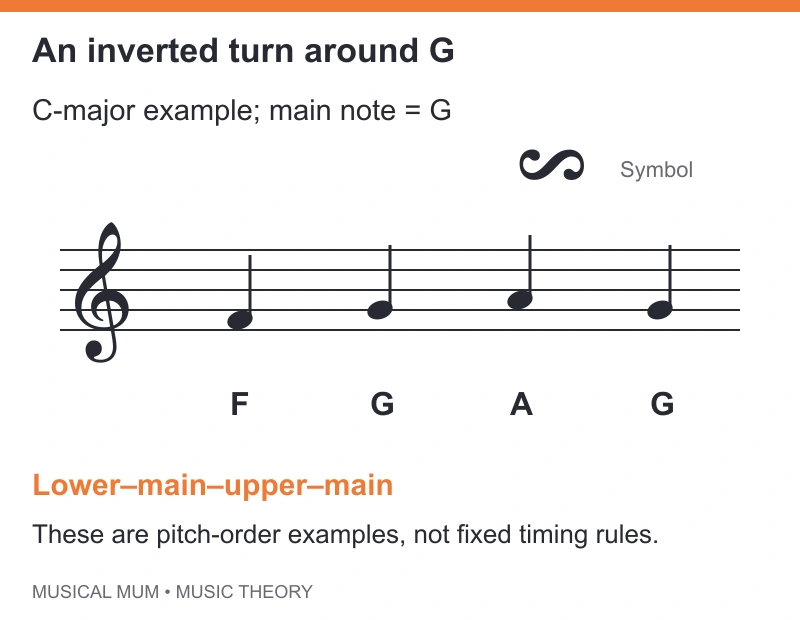
A inverted turn around G in C major uses F–G–A–G. The exact timing depends on where the symbol is placed and the style of the piece.
Inverted Turn
The inverted turn is similar to the regular turn, but the notes are played in reverse order. You start with the note below the main note, followed by the main note, then the note above, and finally the main note again. Its symbol may be a mirrored turn, as illustrated here, or a regular turn with a vertical line through it.
Offset Turn
Sometimes, the turn symbol is placed between two notes, affecting their play. This use of the symbol is called an offset gruppetto.