The terms 3/4 and 4/4 are time signatures. In 3/4, a full measure has three quarter-note beats; in 4/4, it has four. A beat can contain a note, part of a longer note, several shorter notes, or a rest.
In 3/4, count 1–2–3 and begin again at the next bar. In 4/4, count 1–2–3–4. A note can last across several beats, and a rest can occupy a beat.
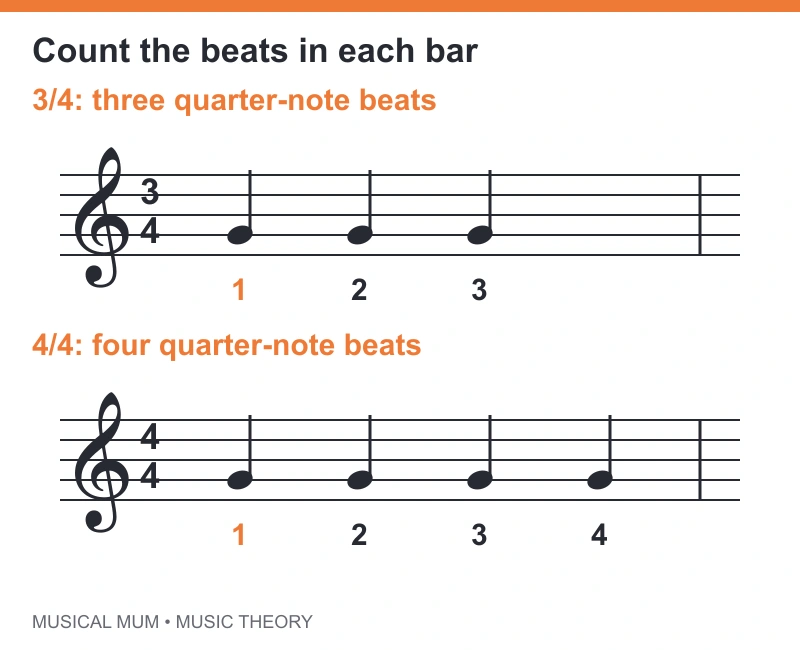
Time signatures tell you the number of beats per measure and the type of note that equals one beat. They organize and measure music.
Time signatures show the number of beats in a measure and the type of each beat. There are two main types: simple and compound time signatures.
Contents
How is music organized and measured?
3/4 and 4/4 time signatures are very common in music. 3/4 is often used for waltzes and ballroom dances. 4/4 is common in most other music styles. The term “Four on the Floor” refers to dance music in 4/4, which is ideal for dancing.
The time signature appears at the start of a piece of music, right after the clef and key signature. It looks like a fraction, with the top number showing how many beats are in a measure and the bottom number indicating which note receives the beat.
How to read a time signature?
The time signature of a piece of music gives key insights into how the music should be played.
In 3/4 and 4/4, the bottom number 4 identifies the quarter note as the beat unit. The top number counts the beats in each full measure.
The top number in a time signature tells you how many beats are in a measure. For instance, in 3/4 time, there are three beats per measure, and in 4/4 time, there are four beats per measure. A quarter note gets one beat in both cases.
A time signature is written as two stacked numbers, but it is not calculated like a mathematical fraction. Read the two numbers as instructions for grouping note values.
The top number counts the beats in these simple meters; the bottom number 4 gives the quarter note one beat. A half note therefore takes two beats.
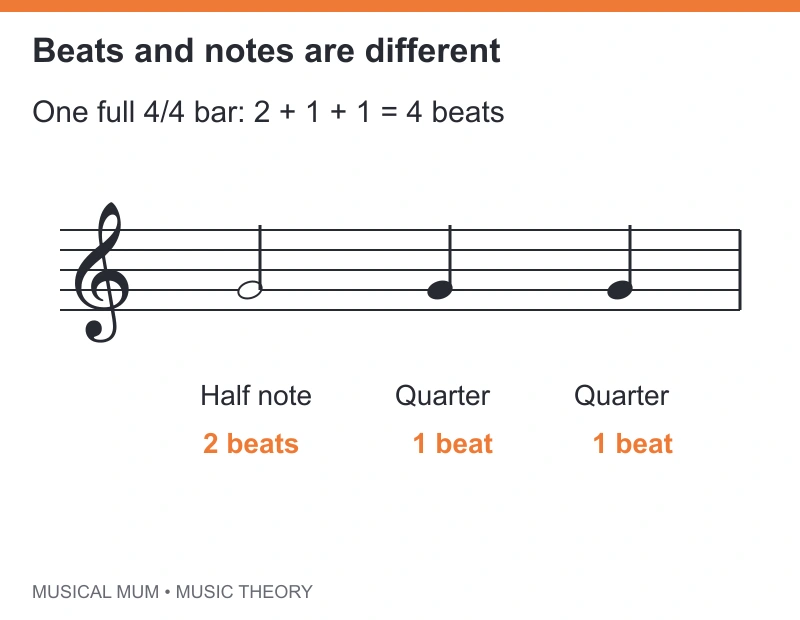
Common time signatures
The 4/4 time signature is the most common in music, being straightforward to read and understand. It’s the go-to for most pop and rock songs, making it familiar to many.
3/4 time signature is common in music. It’s great for waltzes and ballroom dances due to its smooth, flowing rhythm created by three beats per measure.
Many other types of time signatures are worth exploring as they create interesting beats. For instance, the 5/4 time signature offers a more complex rhythm. The 6/8 time signature is popular in Irish folk music, while 9/8 is common in African music.
4/4 vs. 3/4 time signatures
In a basic 4/4 pattern, beat 1 is strongest and beat 3 often has a secondary accent. A pop or rock backbeat commonly emphasizes beats 2 and 4. The score or style can use other accent patterns.
A basic 3/4 pattern emphasizes beat 1, followed by two lighter beats. More complex meters can group their beats in different ways; the number of quarter notes alone does not tell you where every accent belongs.